%20scale(0.100000,-0.100000)'%20fill='%23000000'%20stroke='none'%3e%3cpath%20d='M49%20234%20c-42%20-44%20-43%20-46%20-25%20-60%2011%20-8%2023%20-14%2028%20-14%2015%200%208%20-18%20-18%20-49%20-37%20-45%20-17%20-37%2039%2014%2047%2044%2048%2044%2025%2056%20-13%206%20-24%2013%20-26%2014%20-1%201%205%2019%2013%2040%209%2020%2015%2039%2012%2041%20-2%202%20-23%20-17%20-48%20-42z'/%3e%3cpath%20d='M30%2035%20c0%20-17%206%20-25%2018%20-25%2011%200%2017%208%2017%2025%200%2017%20-6%2025%20-17%2025%20-12%200%20-18%20-8%20-18%20-25z'/%3e%3c/g%3e%3c/svg%3e)
This summer was an epic journey, with Claire and I spending almost 60 days cycling in Mongolia. We picked the country as our destination in pursuit of a truly adventurous journey across steppe and desert. We had some mishaps on the way, but left feeling fulfilled. I wanted to write an anthology of the trip, not only to recap and crack wise, but also to cover some of the things we learned on the way and help anyone else with ideas of traveling here. There wasn’t much information available about the places we wanted to go, so hopefully this is a useful reflection on the trip.
Here’s some approximate numbers. We arrived on June 13th and left on August 10th, with about a week of buffer time on each side. That’s about 45 days of cycling, with an overall distance of about 1,600km cycled. Maybe 60% of that distance was done in only our first couple weeks on paved road. Once we got off tarmac for the latter two thirds of our journey, our pace plunged accordingly. I expected we’d lose some speed on dirt and gravel, but the absolutely miserable conditions of a lot of these roads slowed us considerably. We could easily hit 100km a day on flat steppe, and we’d have a good day if we got half that distance.
We chose our intended route to conjure up a clockwise loop from Ulaanbaatar, since we had a massive amount of time to ride around. We wound up having to take multiple buses to make up for some equipment failures, but still completed that general goal, just more of an arc than a full circle. Those with a shorter timeframe in the country will generally want to get additional transit from UB somewhere exotic, like the Siberian forests to the northeast, the fantastic lakes and mountains of the west, or the Gobi to the south. The areas directly around UB is somewhat featureless, minus the mountain of Khan Bogd in its southern shadow.
Bikes, Maps, Gear
We both brought our tried and true Surly steel bicycles on this trip. It’s fairly easy to fly them boxed on airlines that include checked bags with your fare. I have a 2017 Cross-Check and Claire has a Long-Haul Trucker. Both were fitted with racks and four panniers each, plus a dubious bar bag purchased in Ulaanbaatar for extras. Lacking suspension did hurt on offroads, but setting up 45c tires generally allowed us to cope with most terrain. We really felt it when roads were bumpy though, which was often. We kept them setup with inner tubes instead of tubeless. Though this worked for Claire, who never had a flat tire the entire journey, I had rotten luck with punctures this trip, with around 13 in total. Most were in quick succession while deep in the Gobi, and forced us to get an extract back to the closest town and then subsequently to Ulaanbaatar when no supplies could be found. The ultimate problem was that my rim tape was compromised; we lost a week of touring time tied up in that odyssey. A second bailing out was required in the Khangai mountains, when Claire’s only severe mechanical issue cropped up. Her saddle snapped from all the washboarded roads. It was a freak accident for sure, but thankfully we broke down next to the only shop for miles and were able to get a ride fairly easily, and a replacement shipped in the next city without much delay.
Mongolia’s notorious for having an incomplete mapping of routes, and many offroad trails that lead who knows where. Thankfully, we never got lost. We used Gaia GPS, with a premium subscription, to get a faithful map of the secondary roads and trails connecting the more rural towns that are off the paved highways. It wasn’t perfect, but only really failed us on our first attempt to branch off the highway, on a possible spur to see the Tsagaan Suvarga badlands. The “road” it outlined was just a jeep track through sand that we swiftly bailed on. Claire bought us paper maps as a smart backup, and organized them meticulously, but they ended up waterlogged; we were solely reliant on the Gaia maps with Google Maps offline as a backup and did fine.
Our maps were compromised due to our cheap water bladders puncturing. We bought Evernew’s products found in Japan’s outlet outdoors stores. I had one HydraPak that survived the trip, but we ended up losing 10 liters of water capacity otherwise from these bladders failing us. That amount of capacity was essential in the off-road desert sections of the Gobi, and honestly even then, borderline, to go 100 kilometers through sandy track. That section of hot, dry and remote desert wound up being the most imposing for us in terms of logistical challenge, we were very fortunate these bladders didn’t fail us until the second half of our journey with most of our riding and camping adjacent to rivers. We never needed to carry more than a couple liters.
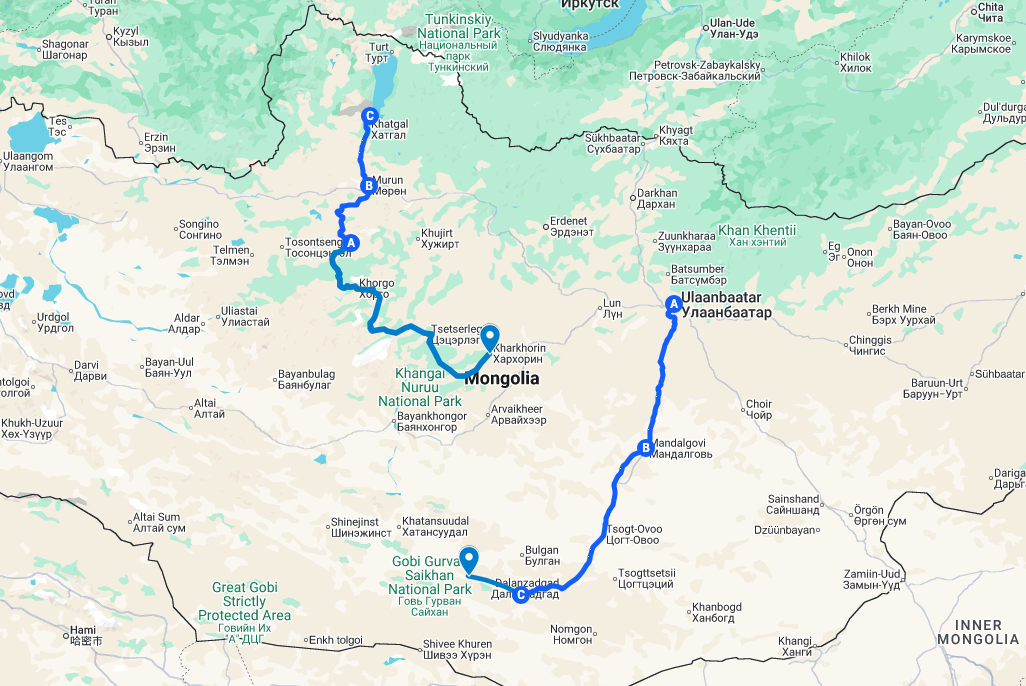
Our Biking Route, with two legs divided over the forced return from the Gobi desert and resuming near Kharkhorin.
Safety, Conditions
Let’s talk a bit more about safety. Our biggest threats were exposure and the elements. I already explained traversing the Gobi, but that area is no joke and required some serious preparation. It’s psychologically intense to ride that far into the desert on a bicycle, not sure of the exact road conditions, and have mechanical issues. My aforementioned breakdown fortunately occurred within a few miles of a resort, for a spot of luck. Claire rode in and got me picked up, and we stayed a few nights in relative luxury gazing at sand dunes waiting for a ride out.
Other difficulties with the elements included extreme lows and highs, both in the first leg of our journey into the Gobi. We started our cycling trip with freezing temperatures and snow flurries in late June, leading Claire to get mildly hypothermic. We were fortunate to warm up in a hotel that night and some additional layers at the frontier town of Zuunmod before truly biking out into the expanse of the steppe. Once we reached the desert capital of Dalanzadgad, the persistent cold front had dissipated and highs were reaching the mid 30’s. Then there’s the pressure on reducing your UV exposure, hydrating and nutrient levels up. Fortunately, temperatures were mild otherwise the rest of our trip, and with very long days we never even needed our bike lights. It’s an ideal summer climate if you want a break from miserable heat. Monsoon storms were the tradeoff, with sudden storms lashing us. We were able to predict their arrival generally, and the flat, wide landscape made it easy to quickly pitch a tent and weather disaster. They always dissipated within an hour, and usually in under twenty minutes, especially the fierce daytime storms that mirrored the furious storms I knew from Arizona summers. I’m just glad the hail and wind that hit us didn’t puncture our tent.
In terms of security otherwise, it felt safe traveling Mongolia. The culture is very much about looking out for one another in the landscape. Often, people checked up on us or said hello on our journey. Motorists, who were very aggressive in Ulaanbaatar’s gridlock, were less threatening in the countryside. I think it’s just the reality of the poor conditions of the roads to force more careful driving. Personal safety was never an issue camping or interacting with people, though occasionally their behavior was overbearing in taking photos or touching our belongings without asking. We understood we were a bit of a traveling curiosity and gracious as could be about it though.
Warnings of aggressive, even rabid, dogs had us on edge also turned out to be nothing. I bought bear spray (that I then couldn’t fly with), and Claire an electronic repellant (a worthless gizmo), so we were essentially unarmed. I have mild trauma for cycling Appalachia and having dogs constantly chase me there, which I frequently had to mace. I expected the worst in a culture that keeps them to shepherd their livestock without the pretense of fences in most areas. Though barking dogs were often seen around individual camps, and occasional packs of haggard strays roamed the small towns, they never took chase, and seemed rather content standing guard and barking. I was glad this one turned out to be just rumor for us.
Claire wound up with some sort of sickness that brought her to the hospital twice over the course of the trip with nausea. It’s not that it was explicitly severe enough to require a hospital, but clinics are sparse outside of Ulaanbaatar, so I believe most medical care happens at the town hospital. We didn’t have travel insurance and never needed it, basic treatment and prescriptions were affordable.
There was a general lack of pests and insects. We brought headnets but never needed them, and I can only recall one night camping near a mountain spring where mosquitoes were a nuisance. Pretty lucky for traveling in summer, compared to my bug-ridden experiences hiking and biking in America’s varied landscapes.
Culture, Quirks, Food
Mongolia has many other curious quirks to go over. How about the cash situation? Although international credit cards worked frequently, cash is still king. There is one major caveat, the largest bill, a 20,000 tugrik note, is worth about $6.50. Although Mongolia is a developing nation where the US dollar goes far, it still leads to comical situations where one winds up with bags full of cash for larger transactions. I made sure to have at least 200,000 MNT in cash at any moment to cover any needs like taxis or hotels. I’d discover later that just about any settlement would always have an ATM, as well as a gas station and mini mart, to cover any basic needs, for a straightforward resupply. I found a lot of other systems dysfunctional, or unnecessarily complicated in Mongolia. An Uber-like taxi app to beat Ulaanbaatar’s congestion didn’t work, and also caused me cash advance fees on my credit card, so I guess we’d just go back to hailing taxis by hand like most other people. It’s pretty interesting seeing any random car just pick up people hailing for a cab. That was a lifesaver when we got a ride to our homestay from the city center after our bus in with 2 big boxes. Buying a bus ticket online had no English support, no pre-purchase more than a couple days ahead, so it really felt like a gamble trying to arrange this standard from of transit. instead of pricey single hires for the long drives we had to do to get around with our bikes between destinations. A passport was required as well for intercity bus travel, the nuisance of which snagged us once.
Probably the single biggest challenge with traveling outside of Ulaanbaatar is that it’s truly the country’s lifeblood, the population is extremely concentrated there, as well as its services. Per Wikipedia, it’s 15.6 times the size of the next largest city, Erdenet. It’s great to travel through vast, empty spaces, but it also means that within these small cities, such as Dalanzadgad, population 30,000, we couldn’t acquire a simple bicycle item like rim tape. There exists an ad-hoc delivery program of cargo delivery using vans and buses between cities, which we used when Claire’s saddle broke, but that’s only available if you have connections. Traveling in Mongolia requires a strong degree of self-sufficiency and some good luck avoiding breakdowns. Even though we broke down twice, we still managed to have a good time despite the delays.
How about veganism? Well, in Mongolia, we expected the absolute worst, and wound up pleasantly surprised. Within Ulaanbaatar, it felt like the restaurant options per capita even outpaced Tokyo, at least per capita. This is thanks to the strong influence of Buddhism, although most of these restaurants had a cultish vibe to them that threw us off slightly. I’m never going to forget watching Supreme Master TV, which was some sorta quasi-religious “wholesome news only” channel these restaurants always had playing. I’ll still take a ‘crazy’ AI Jesus preaching over the ‘normal’ of eating tortured, dead animals.
In terms of the countryside and small towns, our food options of course dimmed. Though we did jubilantly find the occasional treat on the menu out sometimes, mostly we were cooking ourselves or snacking. It was always possible to secure some root vegetables and staples like accidentally vegan instant ramen. Later in the trip, I got really into bread, especially with an ajvar-type spread the stores all sold of pickled vegetables and tomato sauce that is popular Soviet-style fare.
I wound up doing all of the cooking for us this trip, with a MSR Whisperlite International stove, which is designed to use automotive fuel. We had read that white gas for camping was scarce, and that this device would be the best way to ensure we could cook and boil water. Not true! White gas is plentiful if one swings by the large stores in the provincial capitals. When cooking with gasoline, I always wound up covered in soot after handling any cookware. For now, we’re keeping that stove as an item for future kits, but hoping it isn’t needed again anytime soon.
It was kind of comical to have brought that stove when petrol shortages were rampant, with huge lines and shutdown stations everywhere. This headache is sourced from a near-total dependence on Russia for fuel, and its continued flailing about as Ukraine has retailed with strikes on its energy sector. Thankfully I was able to get a top up here and there on my fuel bottle without too much stress, nor did we wind up ensnared when we needed transit.
We made due quite well with phones and books as a primary source of entertainment. Cell service with e-sims worked fine in any town, but rarely further afield. Claire brought two paper books, and picked up a third on the way, while I voraciously consumed ebooks and audiobooks. We managed with 2 power banks and trips with a maximum of 2 days between services generally. I’d personally toss the paper books next time and stay more lightweight, but I brought juggling balls that I only used once before they also got ruined with the bladder spillage. So, I don’t always practice what I preach there.
We had strongly considered taking our bicycles to China as well before settling on Mongolia. While we hope to visit there soon, the additional onus of traveling in an authoritarian nation with a totally parallel world of app functionality gave us some pause. Jumping right into the adventurous side in the realms of Qinghai and Tibet. The facts are that one cannot freely travel there, especially in Tibet and Xinjiang, where escorts are required. Additionally, the summer monsoon season is strong in the mountains of Szechuan and Yunnan I want to see. Those factors, and visa costs, led us to the more rustic route with Mongolia, and its distinct culture. It will be another day for China, likely.
So that’s our summary of traveling here. The views and amenities can seem sparse, after all it took weeks before I saw any amount of trees on the regular after departing Ulaanbaatar. If one is hardy, the reward is really there for the effort. The sand dunes of the Gobi, the crystal clear Lake Khovsgol, and the many ancient relics of empires past are there waiting to be discovered. We even saw hot springs once. There are no regrets at all from either of us on choosing to spend all of our summer camping out there and bicycling far and wide.